

A sunny lunchtime in July is obviously the perfect time to be staring into an undertaker’s window.
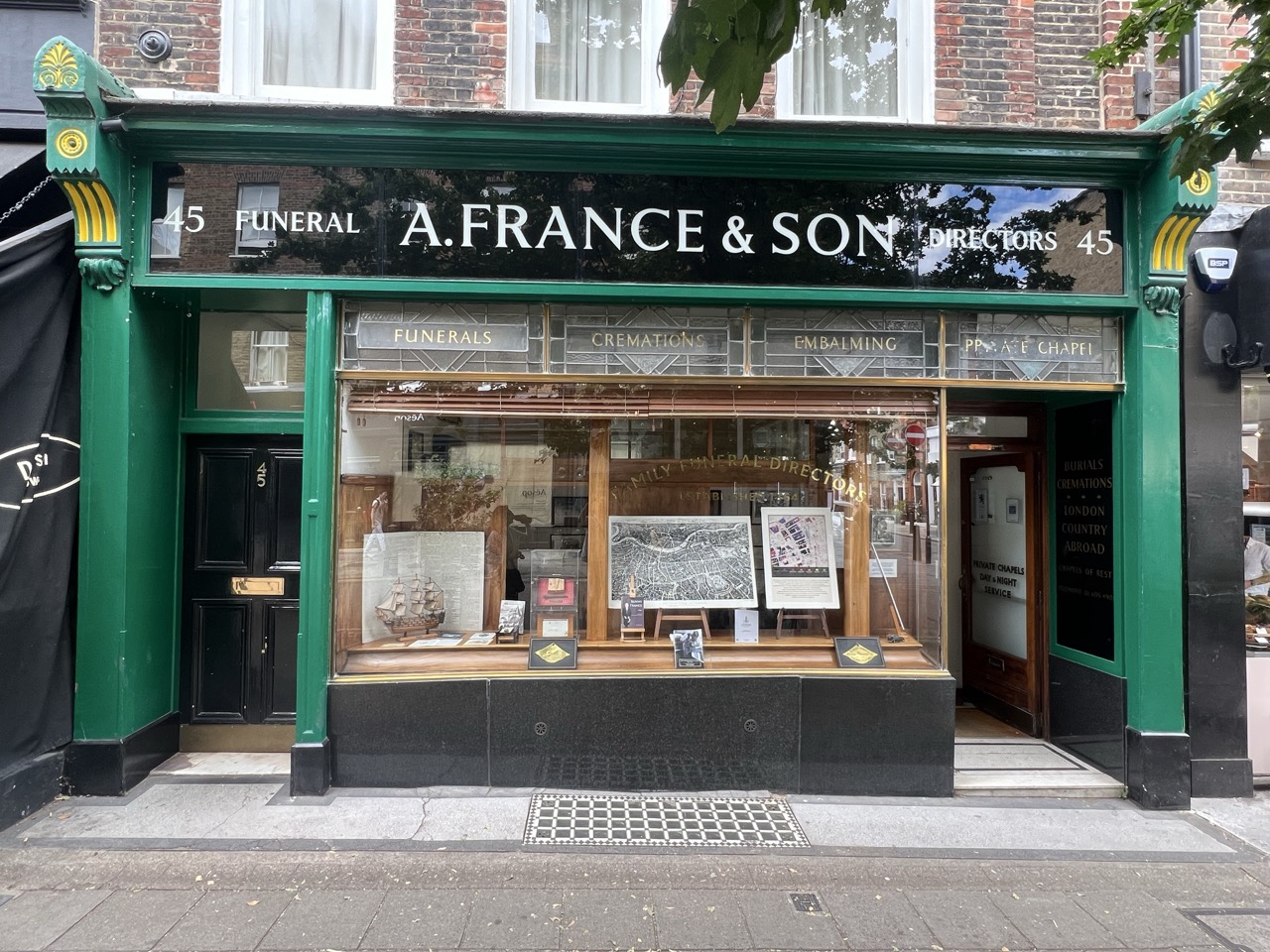
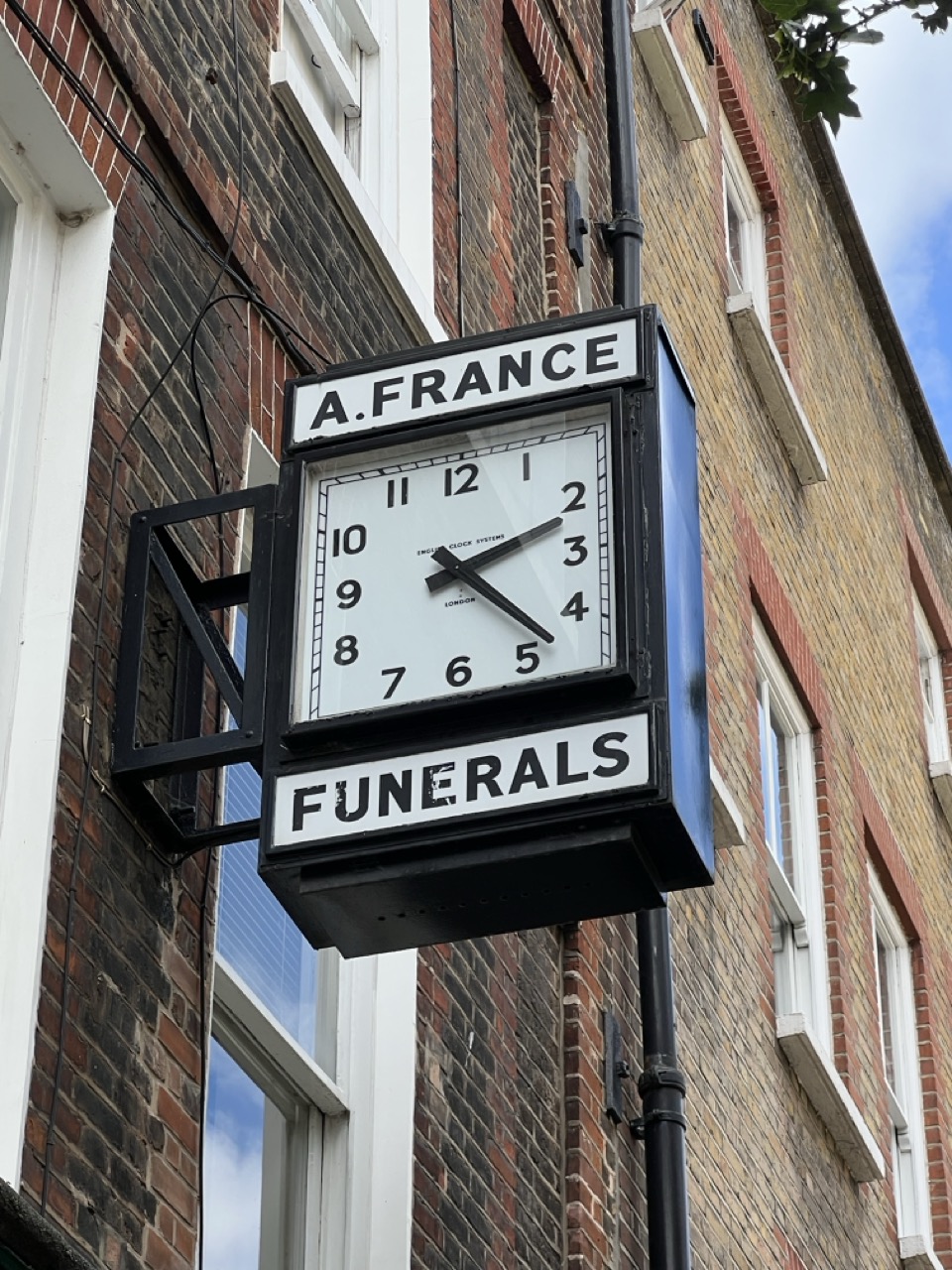
I’m in Lamb’s Conduit Street, a rather chi chi Bloomsbury road that connects Theobald’s Road and Great Ormond Street, and the funeral director’s in question is A France and Sons.
The firm goes back to 1764, when William France established a business as a cabinet maker in Covent Garden. He seems to have pivoted to funerals early, as in 1765 he was the Royal Undertaker for the Duke of Cumberland (“Butcher” Cumberland to the Jacobites of the ‘45 rebellion) and to Prince Edward, the Duke of York and Albany in 1767.
In 1806, after the business had passed to William France junior, the firm was given probably its most high profile job so far, to be involved in the funeral of Britain’s greatest naval hero, Viscount Horatio Nelson.
This funeral was to be such a massive affair – a river flotilla from a lying in state in Greenwich, a funeral procession of over 190 carriages from the Admiralty to St Paul’s, and over 9,000 packed into the cathedral – that the work was split between numerous firms, France being given the job of creating Nelson’s coffin, or, rather, one of the outer coffins, Nelson being within layers, like some macabre Russian doll.

The inner coffin was made from wood from the mainmast of l’Orient, the French flagship destroyed during Nelson’s victory at the Battle of the Nile in 1798, there was then a lead coffin, with France making the outer coffin. This was of mahogany and of ‘spectacular construction’ and used 10,000 gilt brass nails and decorated with gold-plated emblems bearing the admiral’s styles and titles, which was placed in a funeral car modelled on HMS Victory.
France (the irony of the name has only just struck me) were also responsible for the arrangements for the lying in state, which took place in the Painted Hall in the Royal Hospital for Seamen at Greenwich. This took place between the 5th and 7th January 1806, and so great was the press of people wanting to pay their respects to the fallen hero that there was a traffic jam of carriages from the city. Over 15,000 filed past the coffin and when the gates were opened, with many more thousands unable to gain access.
This is because Nelson, son of a country vicar from Norfolk, was the British hero of the age. He had won victories at the Nile, Copenhagen and Cape St Vincent (you can see these on the bronze reliefs on the plinth of his eponymous column in Trafalgar Square) and, at a time when Napoleon’s forces had swept across all of Europe and seemed invincible, his victory at Trafalgar meant that a French invasion of Britain was now impossible.
Nelson had conceived Trafalgar as a battle of annihilation, his tactics – sailing directly into the line of the French and Spanish fleets – relying on superior British seamanship and gunnery to devastate the enemy. And so it proved, with 18 (out of 33) ships of the line of the combined French and Spanish fleets were destroyed or captured. Britain was safe, British naval supremacy was assured and, although it took the best part of a decade to achieve, the seeds of an allied victory over Napoleon had been sown.
But the national hero was dead. “We know not whether we should mourn or rejoice.” said The Times, “The country has gained the most splendid and decisive victory … but it has been dearly purchased. The great and gallant Nelson is no more.”
Rather than be buried at sea according to tradition, the dead admiral was embalmed in a large barrel filled with brandy and brought back to England on his flagship Victory.
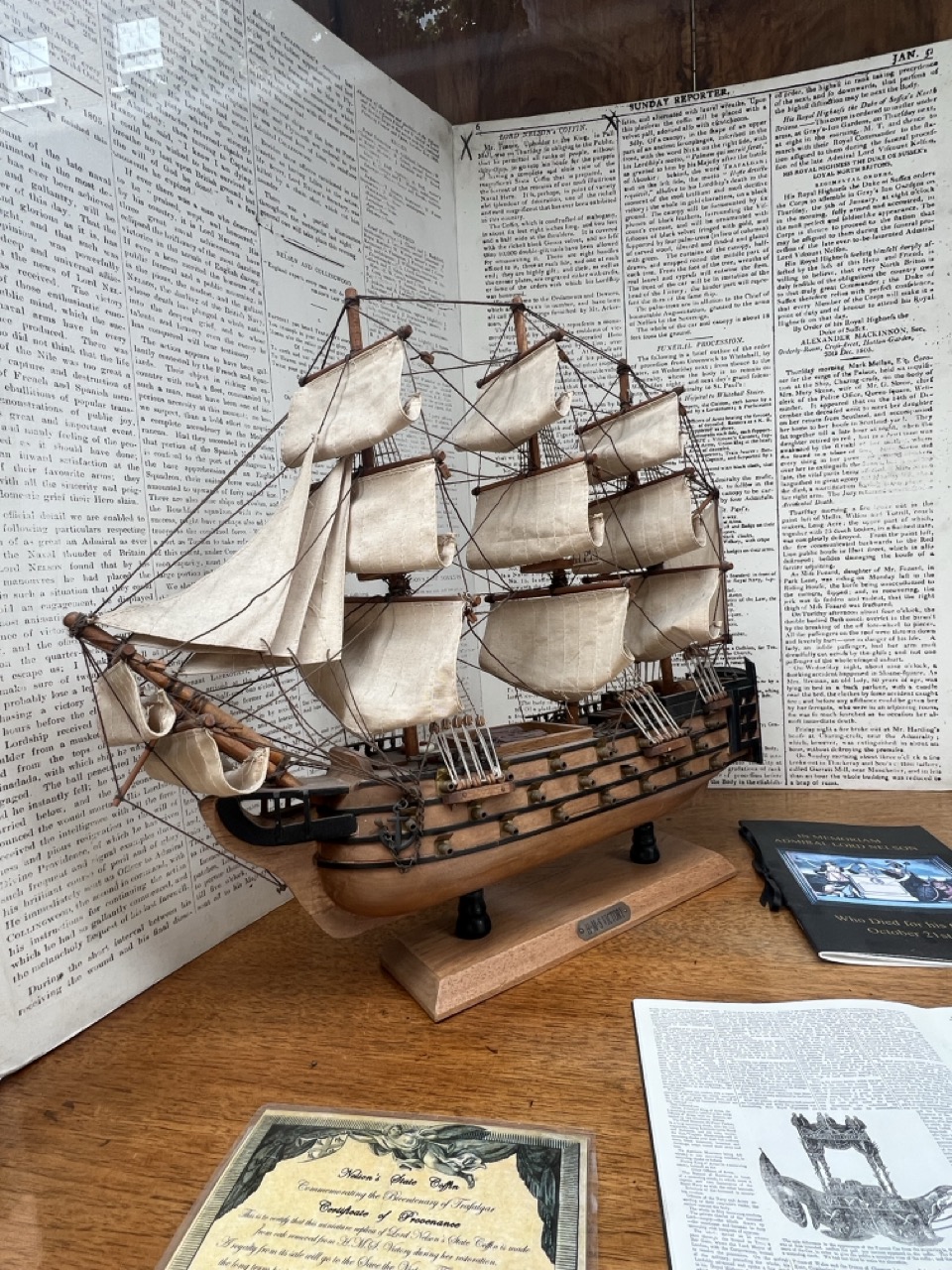
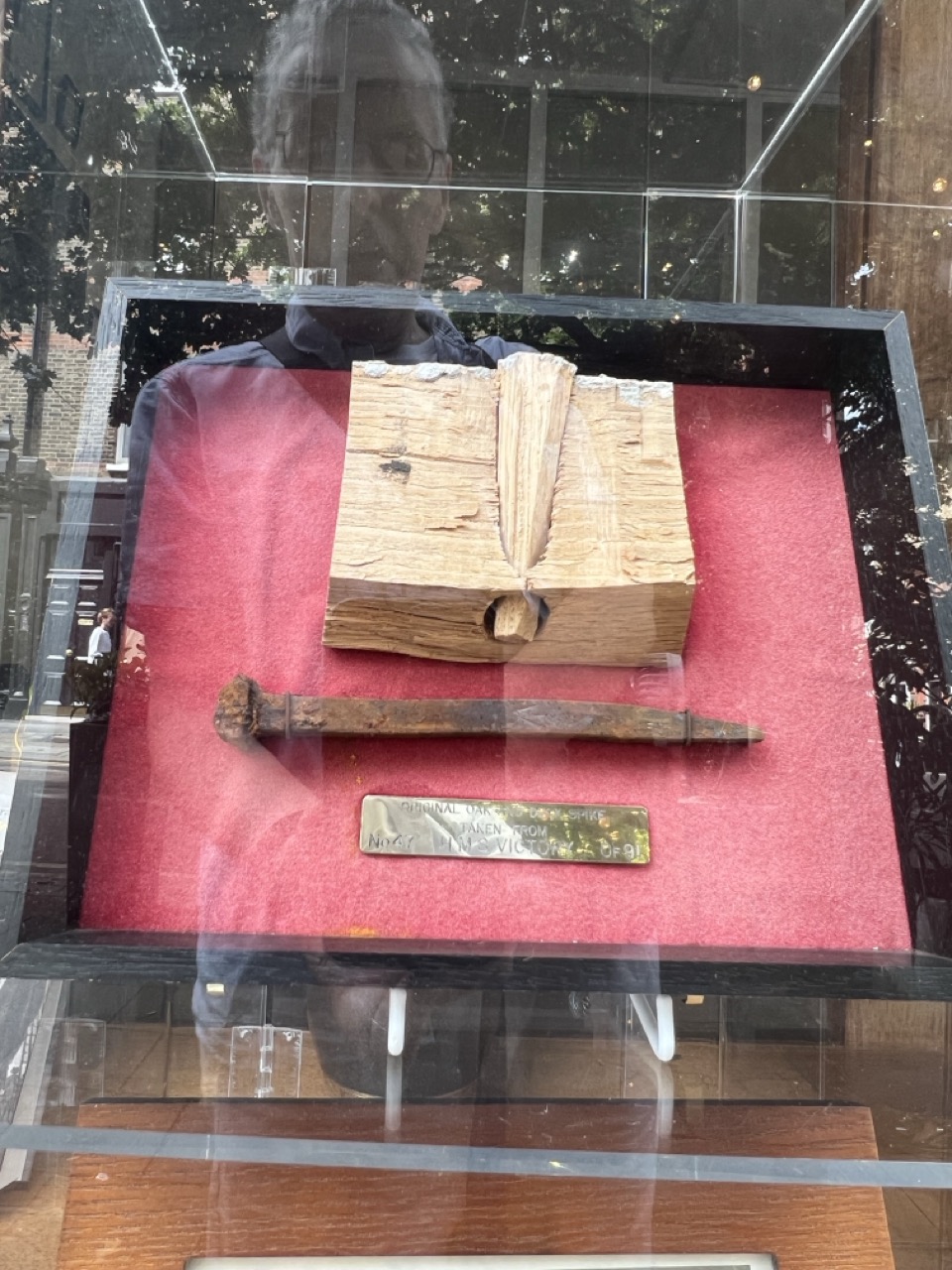
Twelve generations in, A France and Sons are still undertaking funerals, with offices in Islington and Hendon as well as their main branch in Lamb’s Conduit Street (to which they moved in 1898). Peer in that window as I was doing and you can see a model of the Victory, plus wood and nails from the mast of that ship, and a model of the Nelsonian coffin.
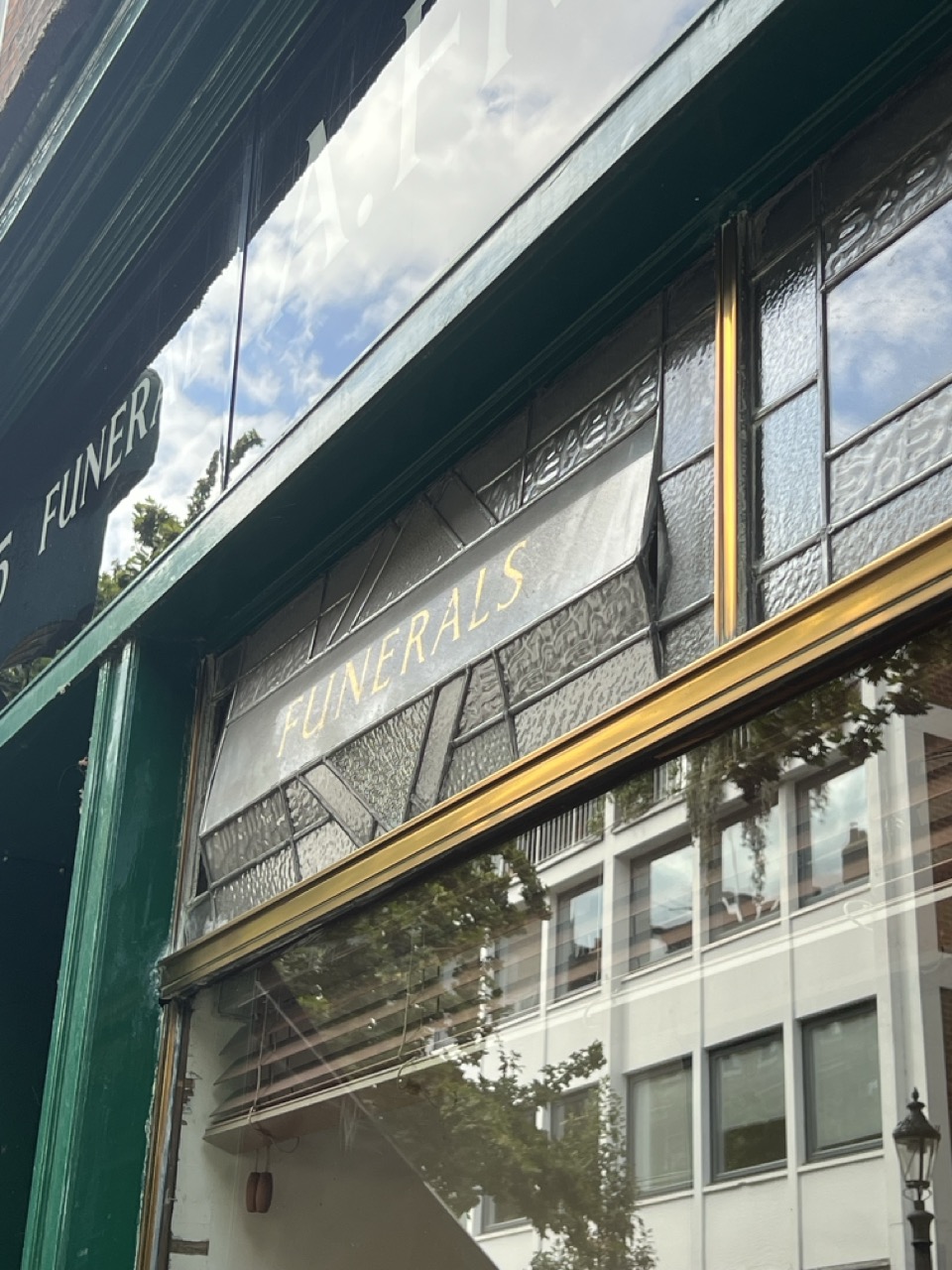
There is also evidence of a later conflict. Look at the top left of the window and you will see it bows out (where it says “funerals”). This is a consequence of the last night of the Blitz on May 10/11 1941. There was severe bombing around Holborn and Theobald’s Road and a bomb blast skewed France’s window which, 85 years later, remains as another kind of memorial.

Leave a Reply