

At the Southwark end of London Bridge, just where it meets Duke Street Hill, is a 16m tall spike.
This was designed by Eric Parry Architects and installed in 1999. It is made up of 25 portland stone blocks weighing 11 tonnes in total, and inclined at an angle of 19.5 degrees to the vertical. The architects gave it the name ‘The Southwark Needle’, although it’s fair to say that almost no one calls it that, nor do many people know what it is meant to represent.
The most popular story is that it is a nod to the heads (“nod”, “heads” – see what I did there?) of the executed that were on display on the top of the Drawbridge Gate on the medieval bridge. (This is the bridge that survived in one form or another for 600 years, from the early 1200s through to 1830. It was one of the wonders of Europe.)
The first head so displayed is thought to be that of William Wallace – ‘Braveheart’ – who was hung, drawn and quartered at Smithfield in 1305, but the practice was so common that it was not too many years afterwards that a ‘Keeper of the Heads’ was appointed. His job was to prepare the heads (which seemed to have involved tarring them to stave off rot), sticking them on a stake and, after a few weeks of display, taking them down. After this they were generally just thrown into the river, although it seems that they could also, should you be wanting a head, be acquired – Sir Thomas More’s daughter bought her executed father’s head and was later buried with it.
After the demolition of the Drawbridge Gate in the 16th century the heads were displayed on the Great Stone Gate at the southern entrance to the bridge. A visitor to London in 1598 counted more than 30 of these macabre tokens. (They can be seen distinctly on Visscher’s famous panorama of London from around the same time.) The practice continued until the 1670s when the display location was moved to the top of Wren’s new Temple Bar at the western entrance to the City in Fleet Street. (I don’t know about you, but hearing that heads on spikes could be seen on the top of Wren’s rather lovely bit of baroque architecture seems like the medieval and the modern overlapping too much.)

So is the Southwark Needle an architectural memento of these old displays? Apparently not. The object has, it seems, a couple of purposes according to the architects, the first being as a marker or gateway for the journey to/from home and work.
From the growth of the railways in the middle of the 19th century, London Bridge was the conduit for tens of thousands of commuters leaving London Bridge station and walking over the river to their jobs in the City. The Needle thus “marks commuters’ entry to, or release from, the world of work”. This is perhaps an echo of the fact that the boundary of the City of London lies just in front of the piece when heading South. (The bridge was always controlled by the City, so the boundary between it and the County of Surrey fell on the Southwark side of the river.)
A crowd flowed over London Bridge, so many,
I had not thought death had undone so many.
Sighs, short and infrequent, were exhaled,
And each man fixed his eyes before his feet.
(From 'The Wasteland' by T S Eliot)
Another purpose is as an indicator of the past. The current bridge crosses the Thames a few metres upstream of the medieval version, and if you follow that 19.5 degree incline down the Needle then apparently you come to the ‘bridge foot’, the place where the river crossing ended and Borough High Street began. (The old bridge ran across the river from St Magnus the Martyr church on the City bank, the portico for which was the pedestrian entrance to the bridge. If you visit the church you can see a rather wonderful scale model of the bridge as it might have looked in 1415.)
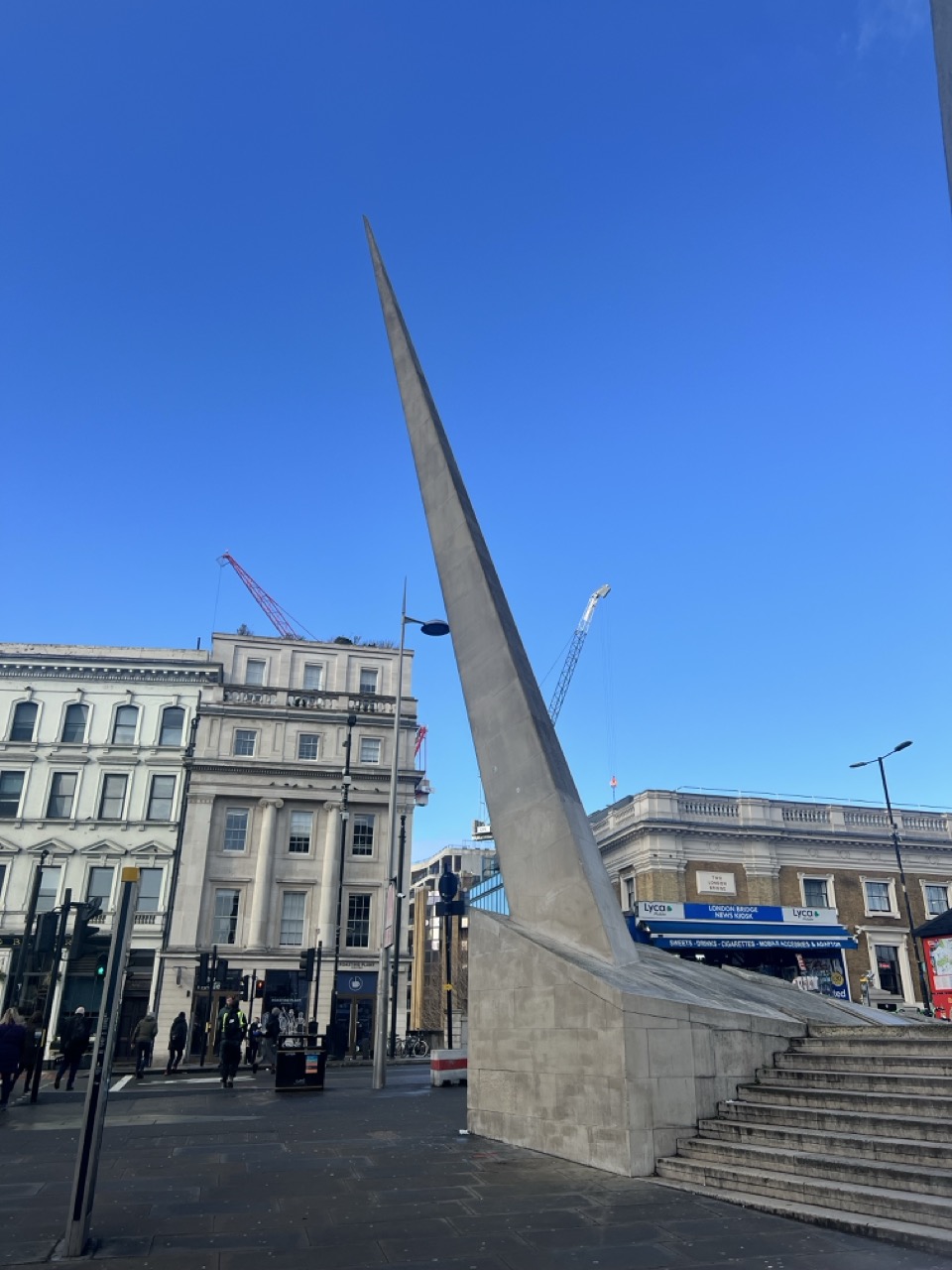
So then, nothing to do with heads on spikes, The Needle is more a boundary post than anything, and if a London tour guide tells you any different then s/he is wrong. But…, to get philosophical for a moment, the ‘meaning’ of an artwork can vary according to an individual’s interpretation of it, so what the architects ‘intended’ for the Southwark Needle 25 years ago can differ from how it is now perceived; its meaning has shifted, and the false idea has become ‘fact’ (in a similar way to how the Westminster clock tower is now known as ‘Big Ben’, when that name strictly refers to one of the bells).
So ignore what was ‘intended’ – next time you pass the spike talk about the executions and the heads. You might not be ‘right’, but you won’t be wrong.
To get a monthly newsletter with my latest blog posts, just enter your email here.
Or follow my facebook page for London posts and photos. And I’m also on Instagram.

Leave a Reply