

To Grosvenor Square, erstwhile home of the US embassy building (which now, completely rebuilt apart from the facade, is the Rosewood Chancery Hotel).
The connections with the USA can still be seen , with statues of presidents Roosevelt, Eisenhower and Reagan, the Eagle Squadrons’ Memorial, and the Diplomatic Gates on the south side of the square that commemorate the bicentennial of the 1783 Treaty of Paris that formalised Britain’s acceptance of the breakaway republic.
It was in this square that Ike’s headquarters were during WW2, and the connections earned this little slice of Mayfair the epithet ‘Little America’. Go to the nearby Mount Street Gardens and the inscriptions on the benches are almost entirely from or about Americans who loved this part of the city.
But Grosvenor Square’s connections with the US go way before the 20th century, back to the earliest days of the Republic, as tucked into the north east corner is number 9, a three stroey townhouse from the tie of George I, which was the home of the first US ambassador to the Court of St James, John Adams.
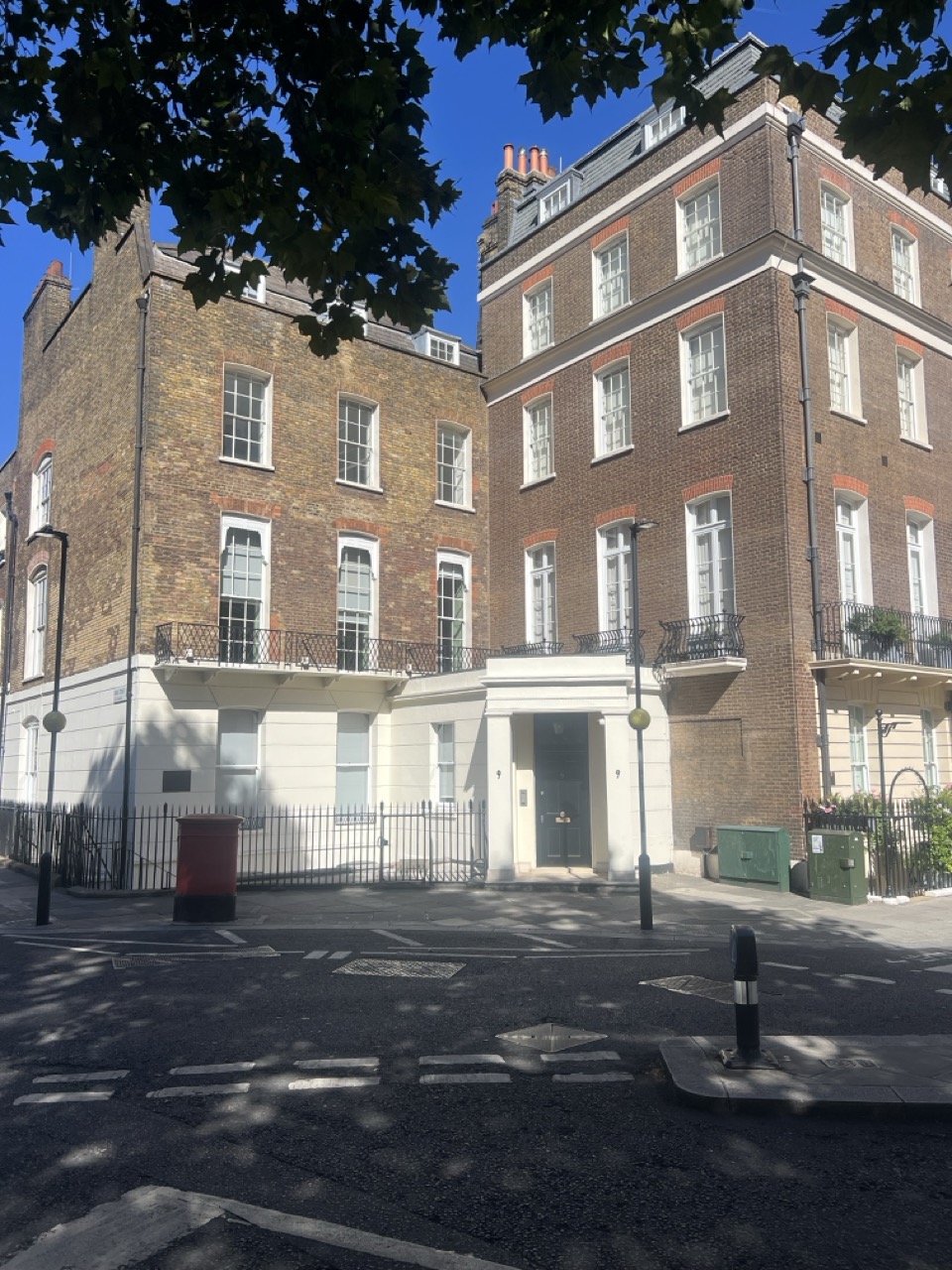
One of the Founding Fathers of the new state, and later to become its first vice-president and then to succeed Washington as president, Adams was ‘Minister Plenipotentiary’ from 1785 to 1788. Despite a relatively cordial first meeting with George III, Adams didn’t seem to enjoy his time in London much. According to the US State Department’s history he “became so frustrated with the cool reception that he closed the legation in 1788 and the post remained vacant for four years“.
The post was reestablished, and Adams’ successors included four more men who would become president: James Monroe (5th President); John Quincy Adams (Adams’ son and 6th President. Quincey Adams’ own son later became ambassador); Martin van Buren (8th) and James Buchanan (15th).
The house is Grade II listed by English Heritage who describe it as “Brown brick with banded stucco ground floor, slate roof. 3 storeys, basement and dormered mansard. 3 windows wide” and there are photos of the inside of the building from a relatively recent renovation of the building here, although it is hard to assess what survives from the 18th century.

On the outside wall of number 9 is a plaque commemorating Adams’ tenure that was erected in 1933 by the rather splendidly named ‘Colonial Dames of America’. Their membership criteria are “women who are descended from some ancestor of worthy life who within the period beginning with the settlement of Jamestown, Virginia, May 13, 1607, and extending to, but not including, the Battle of Lexington April 19, 1775, served one or more of the thirteen original Colonies” and state that “membership is by invitation only“, proving that class and privilege became as important in the USA as they ever were in the mother country.

Leave a Reply