

Westminster Abbey can be seen as many things. It’s a Royal Chapel, the place of coronations, weddings, funerals and burials; a National Church, where services commemorating significant events are held; a Pantheon, honouring the great and good of the British Isles. It also has some of the finest funerary sculpture in the country.
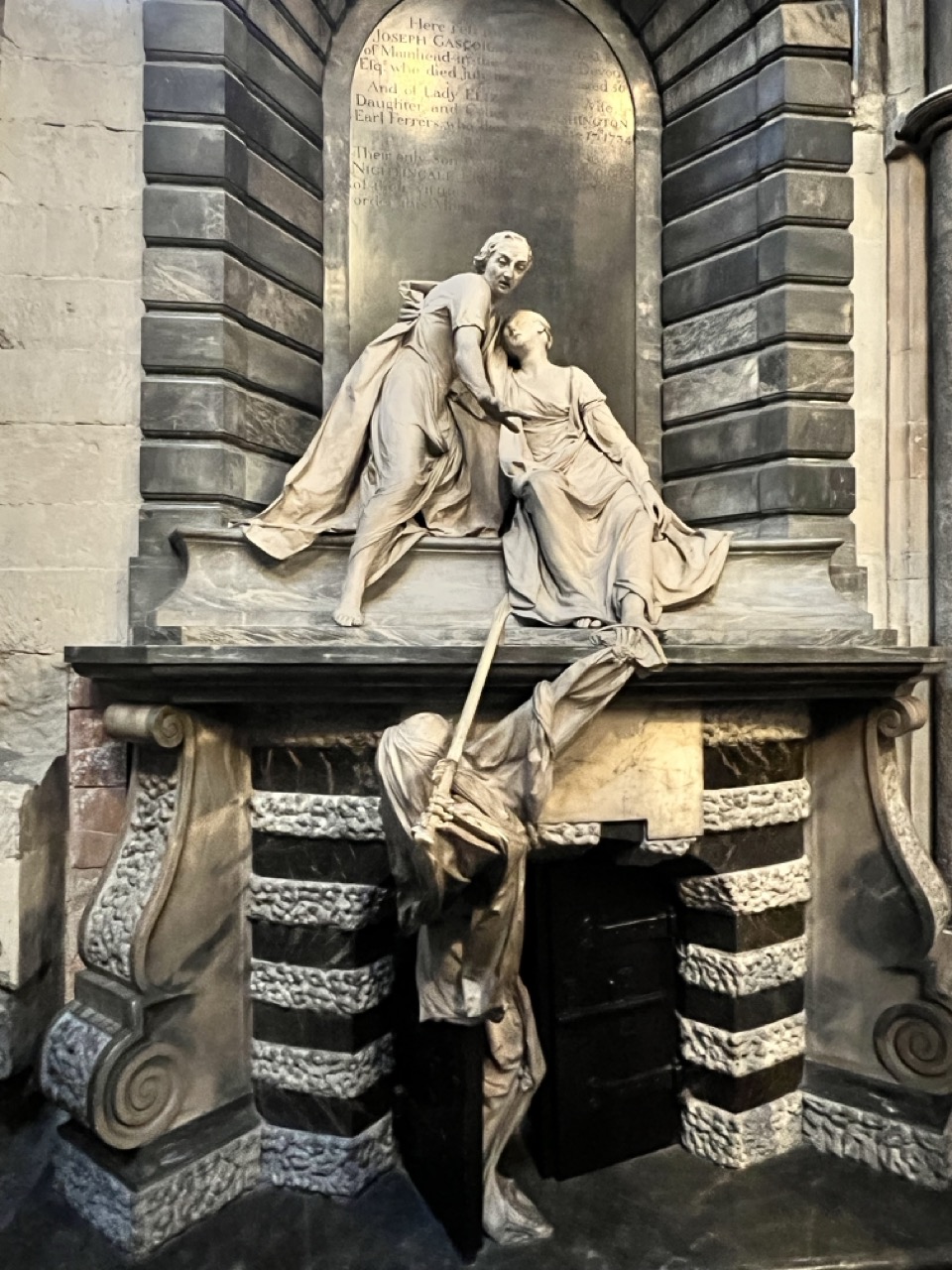
And towards the top of the list of the best – certainly the most striking – examples in the Abbey is the monument to Lady Elizabeth and Joseph Nightingale, commissioned in the will of their son Washington Nightingale and created by the sculptor Louis-François Roubiliac.
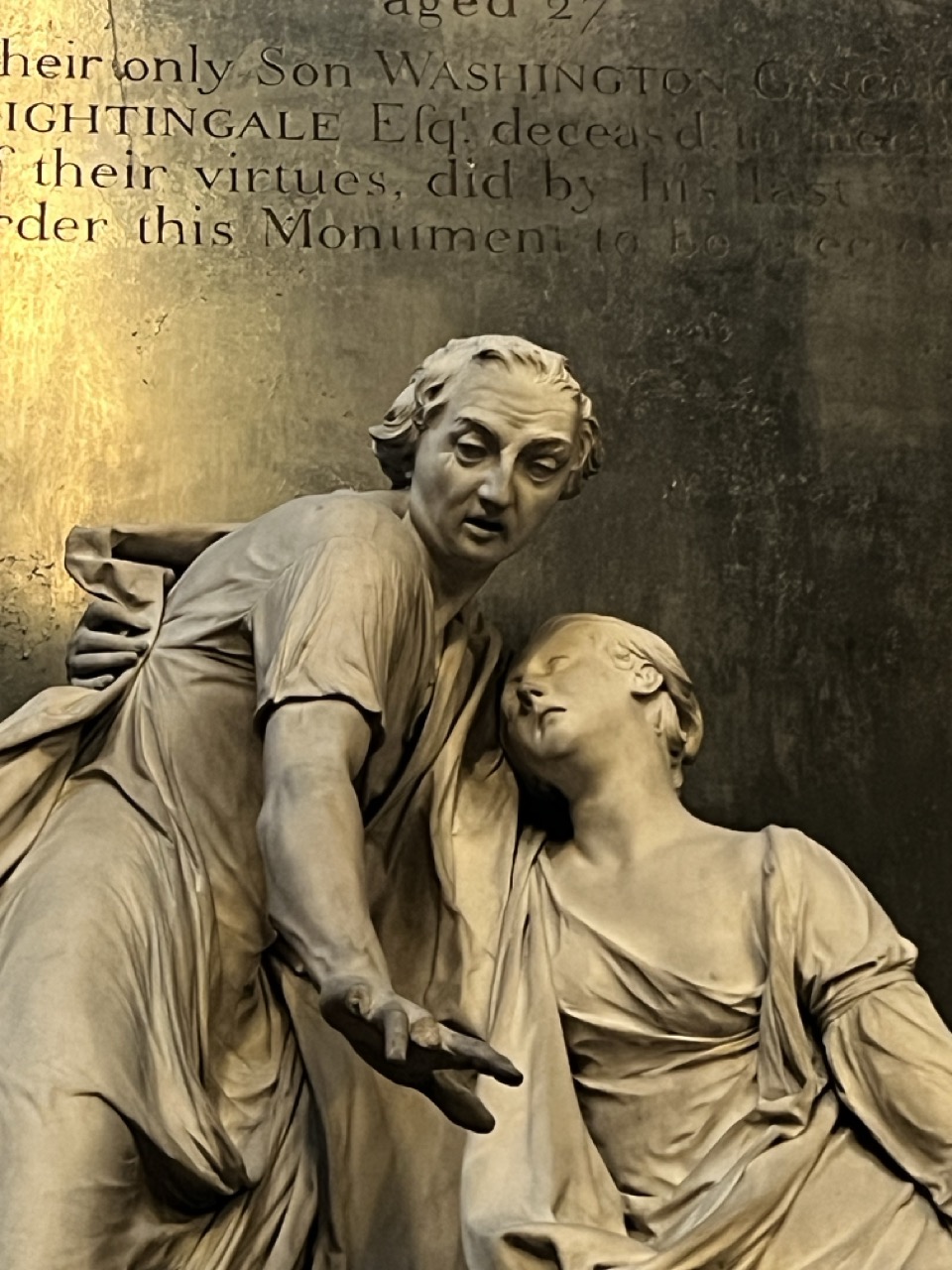
It shows Death – a gruesome, skeletal figure – emerging from the underworld to skewer an unconscious Elizabeth, while Joseph, his face horror-struck, tries vainly to ward off the fatal blow. The message is that Death will always claim its prize, regardless of how much and in what manner he is resisted.
John Wesley called The monument was described as one of the finest in the Abbey, by John Wesley, who said ‘the marble seems to speak’, and Washington Irving declared it ‘among the most renowned achievements of modern art’. (Irving was writing in the early 19th century; the monument was erected in 1761.)

The two mortal protagonists in the drama are Joseph Nightingale, a clergyman in Enfield who inherited a fortune from a relation of his mother and later became the MP for Stafford, and his wife Lady Elizabeth who was the daughter of Washington Shirley, 2nd Earl Ferrers. (An aside – Laurence Shirley, the 4th Earl Ferrers was last peer to be hanged, after being convicted for murdering his steward.)
Lady Elizabeth died in 1731, aged only 26 or 27, following a premature birth that was apparently caused by the shock of a violent flash of lightning. Joseph died aged 56 in 1752, and Washington, their only surviving son, died just two years later.
Roubiliac the sculptor had a long career in London after moving to the capital from his native France. His most famous work is probably the full length sculpture of the composer George Frideric Handel that he executed for the Vauxhall Pleasure Gardens which can be seen in the V+A (Roubilliac’s monument above the grave of Handel is also in the Abbey). His bust of his friend William Hogarth is in the National Portrait Gallery, and there is a Roubiliac statue of Shakespeare in the British Library, commissioned by David Garrick.
You can find the Nightingale Monument in St Michael’s Chapel, the entrance to which is just to the left of the Wolfe of Quebec monument in the Abbey’s north ambulatory.


Leave a Reply