

To “find yourself in Carey Street” used to mean you were broke, because this is where the main Bankruptcy Courts were based in the late 19th century. (This became corrupted to “on Queer Street”.)
The courts are still there (for county court judgements), and Carey Street retains a legal and a Victorian feel as it is the thoroughfare at the back of George Edmund Street’s neo-gothic Royal Courts of Justice building that fronts onto Strand. (If you asked AI to generate a picture of over the top Victorian architecture the chances are it would come up with something like the Royal Courts.)
But I digress (again), because the law and architecture don’t concern us today; we’re off to the pub.

This pub is a very fine boozer called the Seven Stars, which sits in 53 Carey Street. It is Grade II listed, and claims to be London’s oldest pub, dating back to 1602 (spoiler alert: it probably isn’t, and it definitely doesn’t). More on that later, but it is definitely in with a shout to be one of London’s smallest, each of the three rooms it has being only about 4m (13′) from front to back. And this is after the pub was extended, most recently in 2004 when the small shop next door was acquired. That shop sold legal wigs, hence the extension’s name: The Wig Room. Go back to the 1870s and the pub was smaller yet, consisting of just the central room where the bar is.
At 5:40pm on a wet Thursday in February it didn’t seem too busy by London standards, but by 5:55 it was packed to the gunwales, standing room only, and even then tightly packed. (On dry evenings the pavement outside essentially functions as an extra room, allowing you to get to the bar without having to use your elbows too much.)
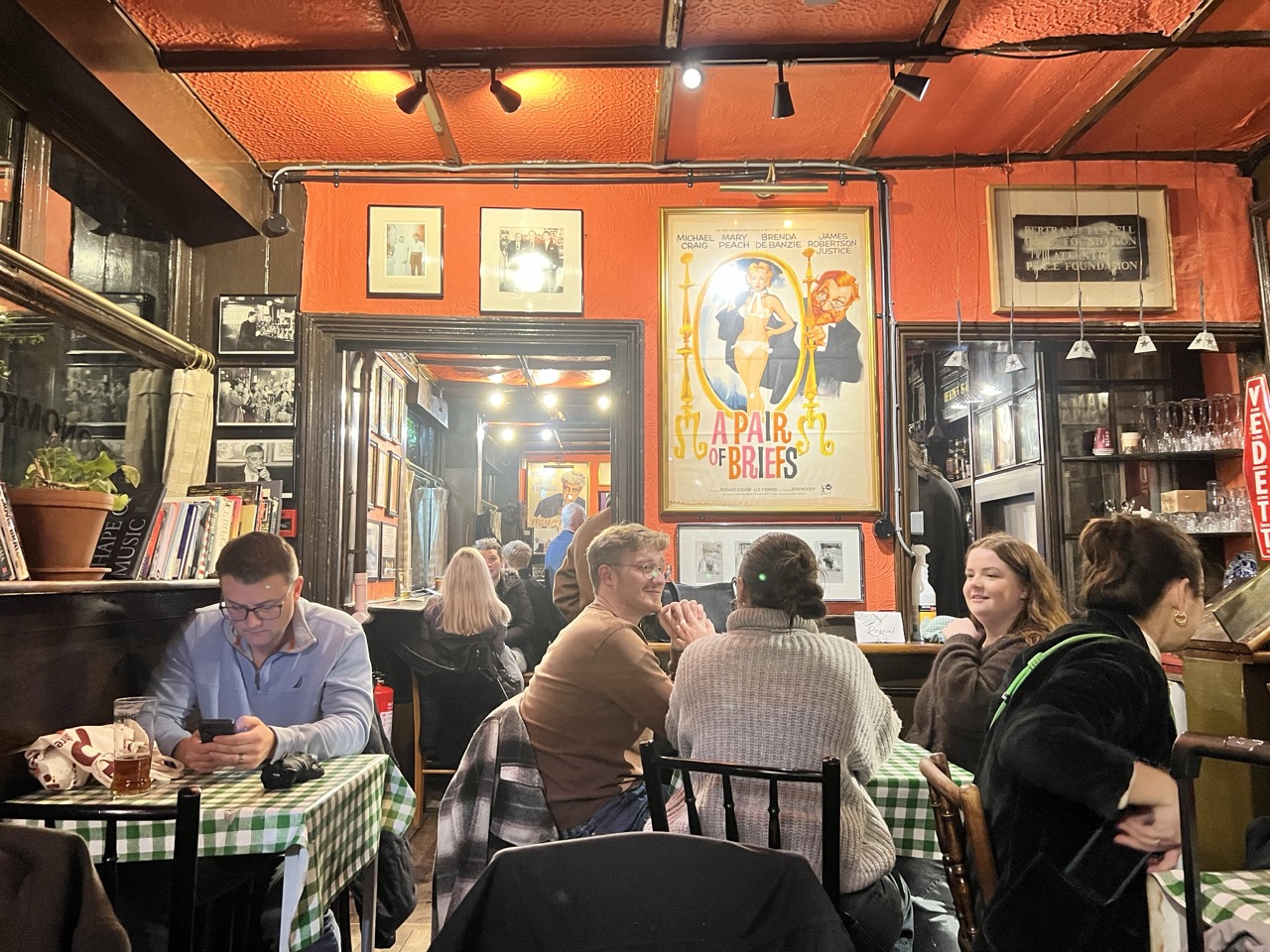
It’s a good pub, decorated with film posters from 1950s legal comedies and black and white photos and film stills, and I plan to visit it again (hopefully on numerous occasions). It is certainly a venerable institution, with a rich and colourful history, but the oldest pub in central London? I think I may be about to get myself barred.
The pub’s website claims that there are ‘credible attestations’ that it was built in 1602 and can therefore be classed as Tudor. As the 1666 Great Fire was stopped a few hundred metres to the east it is a survival from pre-Fire times which, given the extent of the destruction of the City, no boozer in the Square Mile can claim. They even say that the staircase up to the loos (precipitously steep and very narrow, to be tackled thoughtfully when you’re four pints in) is ‘Elizabethan’. The legend of its longevity is repeated on just about every London- and pub- history website that pops up on google (e.g. Camra or even Wikipedia).
The problem with all this is that when you look at the maps from the late 17th century (as always, Layers of London is your friend here), the north side of Carey Street is, literally, fields, open space. There was nothing where the pub is until around 1700. And even then we don’t know when it opened as the site is not marked ‘PH’ (‘public house’) on maps until the 1800s (although earlier maps didn’t generally show such information).


We live in a post-fact age, and when it comes to pubs (and stories about and within pubs), we have to allow a certain elasticity in our adherence to the strict truth. I suggest you visit, have a couple of beers, then tell your friends you’ve visited “what’s said to be” the only Elizabethan drinking establishment that still survives.
To get a monthly newsletter with my latest blog posts, just enter your email here.
Or follow my facebook page for London posts and photos. And I’m also on Instagram.

Leave a Reply